
Five hundred million people worldwide live directly under the shadow of an active volcano. For most Americans, that sounds unimaginable. For communities across Indonesia, Hawaii, Iceland, Italy, and Ecuador, it is simply home — a place where extraordinary natural risk and extraordinary natural reward exist side by side. The fertile soil, spiritual traditions, economic opportunities, and daily realities of volcano life tell a story most Americans have never heard.
Half a Billion Neighbors

University of Richmond geology researchers confirm that 500 million people globally live near active volcanoes. Their reasons range from deep cultural ties and religious tradition to economic opportunity and, for the most vulnerable communities, limited financial ability to relocate regardless of the known risk involved.
Soil Feeds Families

Volcanic deposits contain iron, magnesium, calcium, potassium, and phosphorus — minerals producing some of the world’s most fertile agricultural soil. Fresh ash acts as natural fertilizer, and volcanic soil retains moisture longer than most non-volcanic farmland, producing consistently strong harvests across Indonesia and the Philippines annually.
Merapi’s Million Residents

Approximately one million people live within 20 miles of Mount Merapi in Central Java, Indonesia. In 2010, a single eruption killed 250 people. Despite the tragedy, the majority of survivors chose to remain because abandoning their crops would have meant complete and immediate financial ruin for their families.
Hawaii Stays Put

When Kilauea’s East Rift Zone erupted through Leilani Estates, hundreds sought temporary shelter locally. One resident told Time magazine her family had knowingly purchased in Lava Zone 1 and fully intended to rebuild afterward. Kilauea remains the most continuously active volcano on Earth today.
Sacred Ground Always

For the Tenggerese people of Java, Mount Bromo is literally the home of gods. Every year during the Yadnya Kasada festival, pilgrims carry livestock and agricultural offerings to the crater rim to pray and present sacred offerings directly at the volcano’s active edge.
Iceland Runs on It

Iceland generates 70 percent of its total electricity from geothermal volcanic energy. Groundwater heated by underground magma drives power station turbines across the country, heating nine out of every ten Icelandic homes year-round. For Icelanders, living near volcanic activity is an energy strategy, not a risk calculation.
Sulfur Miners Descend Daily
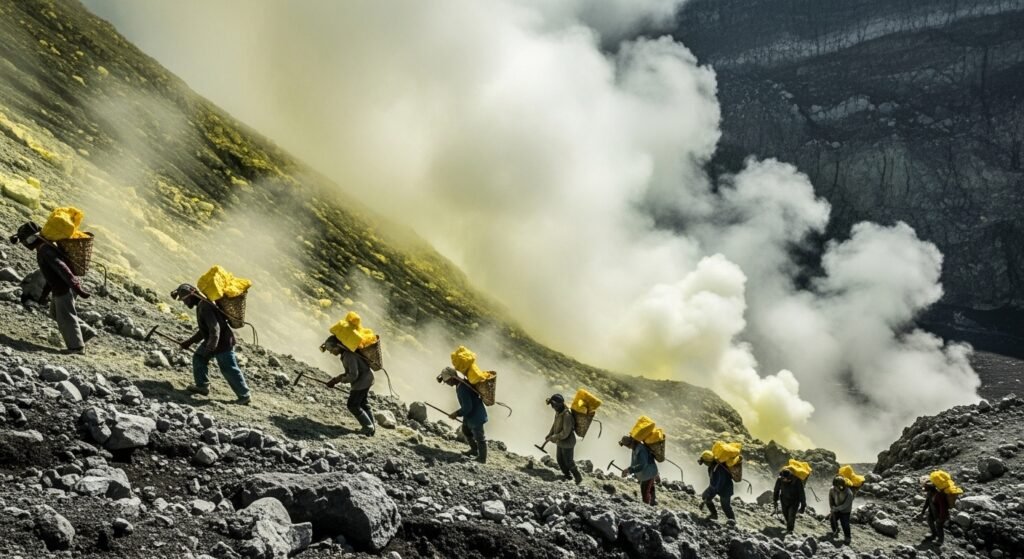
On Java’s Kawah Ijen volcano, miners descend daily into an active crater to excavate bright yellow sulfur by hand, then carry blocks weighing up to 175 pounds up steep crater walls. Extracted sulfur supplies fertilizer production and manufacturing operations throughout East Java’s industrial sector.
Ash Becomes Advantage

British Geological Survey researchers confirm that farmers surrounding Ecuador’s Tungurahua volcano — which erupted continuously from 1999 to 2016 — learned that seasons following moderate ash deposits consistently produced stronger harvests, effectively turning a recurring natural hazard into a measurable and reliable agricultural advantage over time.
Tourism Pays the Bills

Pompeii attracts nearly three million visitors annually, making it one of Italy’s highest-revenue archaeological sites. Mount Bromo, Iceland’s Strokkur Geyser, and Hawaii Volcanoes National Park collectively generate hundreds of millions in annual tourism income directly benefiting the communities living closest to active volcanic sites
